
This article was born from the hands and heartfelt concerns of Trifina Oktaria Denti, a young woman from Sintang who devoted her heart and life to the struggle of indigenous peoples. She was active with the Sintang Indigenous People Alliance and grew within Gemilang, a youth incubation space in Sintang. For Ria, writing and photography were not merely forms of expression, but ways of preserving memory, safeguarding and documenting culture, and voicing sustainability from the perspective of her generation. Before this article could appear in the public sphere, she had already passed away. Her passing left deep sorrow, but also a legacy that will not easily fade. Through this writing, we do not merely read her ideas, but we also feel her spirit–a small flame that hope will continue to burn, inspiring more young people to stand up, speak out, and care for their land and culture with love and courage.
Amid the ever-growing bustle of the city, in the heart of Borneo that still preserves the remnants of Kalimantan’s lush green landscape, stands a giant rock that is not merely a geographical landmark, but also as a spiritual and cultural symbol for the local people: Bukit Kelam. Located in Sintang Regency, West Kalimantan, this magnificent monolith rises 1,002 meters high, inseparable from the nature and life that surround it. Located around 20 kilometers from the town center, Bukit Kelam is often compared to other great monoliths of the world such as Uluru in Australia or Sugarloaf Mountain in Brazil. Yet what makes Bukit Kelam distinct is its setting, nestled within a rich and humid ecosystem where thousands of species depend on each other in a fragile yet awe-inspiring web of life.
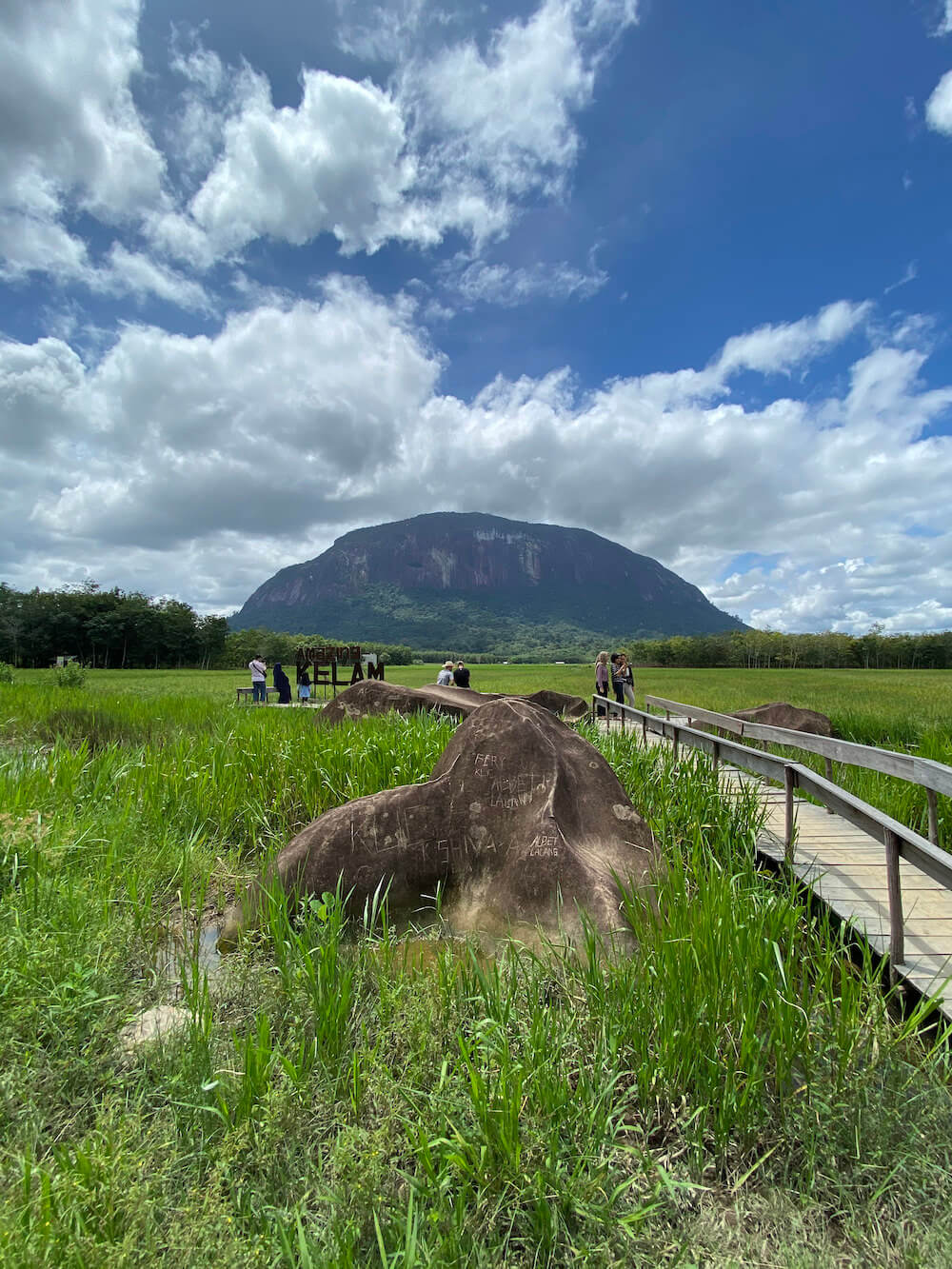
The appeal of Bukit Kelam lies not only in its geological grandeur but also in the deep spiritual values that accompany it. For the local Dayak people, Bukit Kelam is a sacred space where ancestral spirits dwell. Legends passed down through generations tell stories of strength, greed, envy, and failed ambition.
These legends are not mere bedtime tales for children; they serve as ecological metaphors that remain relevant today. The figure of Bujang Beji, a powerful young man who is central to the story, is believed by local people to have used tuba poison to catch fish, reflecting the damage that arises when humans exploit nature without limits. In contrast, Temenggung Marubai, who wisely harvested natural resources more wisely, represents the principles of sustainability and balance.
When Bujang Beji grew envious of Temenggung Marubai’s abundant catch, he decided to block the flow of the Melawi River with a giant rock. However, on his journey, the giant stone he carried using seven blades of grass fell after celestial maidens mocked him, causing him to lose his strength. In this legend, Bukit Kelam stands as a silent witness to the eternal struggle between greed and wisdom, exploitation and preservation.
The slopes of Bukit Kelam are home to rare wild orchids, various species of pitcher plants, and trees that serve as life sources for Kalimantan’s endemic fauna. This biodiversity is not only a biological asset, but also a part of cultural wealth protected through local wisdom. For the Dayak community, the forest is not merely a green space, it is part of their identity and way of life.
Beyond its cultural and ecological value, Bukit Kelam holds great potential for conservation-based tourism. Its hiking trails offer challenges for adventurers and nature lovers, along with breathtaking panoramic views. From the summit, vast stretches of tropical forest unfold, with Sintang City visible in the distance, veiled in thin mist and accompanied by the tranquil sounds of nature.
Unfortunately, like many other tropical regions, this area is not entirely safe. Deforestation, land conversion, and economic pressure remain major challenges. Yet hope endures. The local government, together with community groups, has initiated conservation efforts not only to protect the ecosystem but also to pave the way for sustainability-based tourism. This approach positions the people as active guardians of their land, not passive observers.
The hiking routes are built with both visitor safety and environmental preservation in mind, while tourism activities are designed to strengthen, not harm the existing ecosystem. This serves as an example of tourism that lives in harmony with nature.
In the face of the climate crisis and the global decline of tropical forests, Bukit Kelam stands as a symbol of hope and a reminder of the vital balance between humanity and nature. Though it does not speak, its presence conveys a powerful message that preservation is not merely a moral duty, but an urgent necessity for the continuity of life.
Bukit Kelam is not just a giant rock in the middle of the forest. It is a complete narrative of spirituality, culture, and nature, a majestic silence that carries the legacy of harmony, meant not only to be seen and admired, but also to be respected and protected.